


Does programmatic advertising really work? Here’s a quick answer:
- Efficiency: Programmatic advertising uses automated technology that makes the ad buying process rapid and reliable.
- Increased Reach: Consolidation of campaigns using programmatic advertising can increase reach efficiency by up to 11%.
- Personalization: By leveraging user data and behavior patterns, ads can be placed precisely for a more significant impact.
- Scalability: Due to the use of AI and machine learning, programmatic advertising can be easily scaled up or down based on needs.
Now, let’s dig a little deeper. Programmatic advertising—the use of automated technology to buy and sell digital ad space—has emerged as a powerful tool in the digital marketing arsenal. Automated technology combined with smart user data not only makes the process more efficient but also allows for precision targeting. Sounds too good to be true? You’d think so, but the impressive growth in programmatic advertising highlights its undeniable potency.
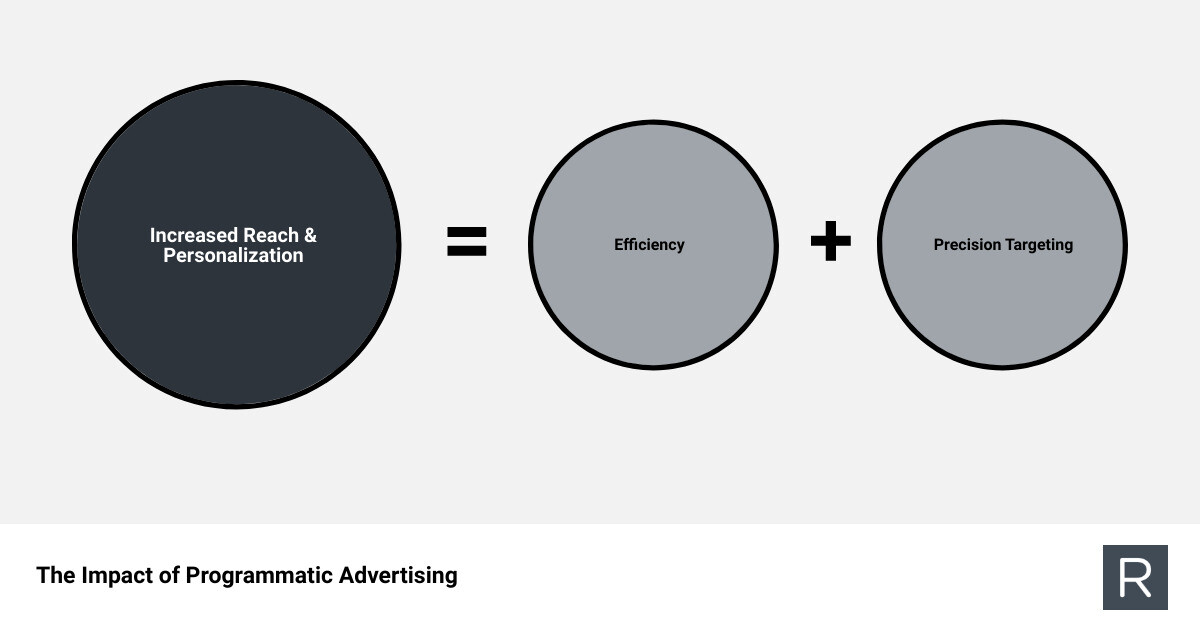
At Raincross, we’ve observed the transformative power of programmatic firsthand. With access to real-time insights and the ability to automate ad buys, programmatic advertising presents seemingly endless opportunities for businesses of all sizes to enhance their reach and efficiency.
However, understanding the real impact and efficacy of programmatic advertising requires digging under the surface and exploring both its potential benefits and the accompanying challenges. We’ve prepared this guide to provide you with an in-depth understanding of programmatic advertising and help you make informed decisions for your business. Let’s get started.
The Mechanics of Programmatic Advertising
To fully grasp the answer to “does programmatic advertising work,” understand its mechanics. Programmatic advertising is an automated, data-driven approach to ad buying that accelerates and enhances traditional methods. Here’s how it works.
The Role of Data in Programmatic Advertising
Programmatic advertising’s magic lies in its data-driven nature. With access to rich data, we can identify and reach the right audiences, at the right time, with the right message. This data includes online behavior, interests, demographics, and more. It’s this data that allows us to target our ads with precision and efficiency.
An integral part of this is real-time bidding (RTB) technology. As its name suggests, RTB enables us to bid on a single ad impression in real-time. It uses user data, behavior patterns, and real-time insights to automate precise ad buying on a large scale.
The Process: From Ad Auction to Optimization
So, how does programmatic advertising work in practice? It’s a four-step process:
Targeting: When a user visits a website, the publisher’s platform puts the ad space up for auction. Simultaneously, the Demand Side Platform (DSP) uses activity data to determine which ads would be relevant to that user.
Bidding: In mere milliseconds, the DSP automatically calculates and places bids for that ad spot based on the data.
Ad Serving: The advertiser with the highest bid wins, and their ad immediately appears to the visiting user.
Optimization: With every ad impression served, we gather performance data. This data helps us optimize future bids and improve targeting.
The entire process happens in the blink of an eye, making programmatic buying incredibly efficient.
Key Players: Ad Exchanges, DSPs, and SSPs
The programmatic advertising ecosystem consists of several key players. To simplify, we can divide them into three groups:
Advertisers: This is us, the ad buyers trying to reach target audiences. We use DSPs to buy ad inventory and manage campaigns.
Publishers: These are the owners or managers of websites with ad space to sell. They make their ad impressions available through Supply Side Platforms (SSPs).
Ad Exchanges: These digital marketplaces connect us, the advertisers, with publishers. The exchange happens through auctions facilitated by platforms like Zemanta by Outbrain.
We access ad exchanges via DSPs to bid on and buy ad impressions from publishers who plug into exchanges via SSPs. This streamlined process is what makes programmatic advertising so powerful and effective.
By understanding the mechanics behind programmatic advertising, we can better appreciate its potential and effectiveness. In the next section, we’ll delve into how we evaluate this effectiveness and discuss the power of precision and the impact of automation.
Evaluating the Effectiveness of Programmatic Advertising
When the question “does programmatic advertising work” arises, the short answer is a resounding yes. But to truly understand its potential, we need to delve into the specifics of its effectiveness. We evaluate this by looking at the power of precision in targeting audiences, the impact of automation on efficiency and improved outcomes, and real-life success stories.
The Power of Precision: How Programmatic Advertising Targets the Right Audience
Programmatic advertising’s strength lies in its precision. This precision is driven by the use of user data and behavior patterns, allowing us to target specific audiences with a level of detail traditional advertising methods can’t match. This data-driven approach ensures that your ads reach the right people at the right time, leading to better engagement and conversion rates.
By combining first-party data (information collected directly from your audience) with third-party data (information from external sources), we can gain deeper insights into your ideal consumer. This ability to target data-driven custom audiences rather than broad demographics or channels is what sets programmatic advertising apart.
The Impact of Automation: Efficiency and Improved Outcomes
Automation is another key factor in programmatic advertising’s effectiveness. It combines AI and machine learning to automate the sale of ad inventory in real-time, leading to increased efficiency and improved outcomes.
The real-time bidding process in programmatic advertising happens in the blink of an eye, allowing us to strategically direct resources towards the campaign during peak times when potential customers are most likely to engage. This efficiency isn’t just about speed; it’s also about cost-effectiveness. A Nielsen study found that brands consolidating their campaigns using Programmatic Guaranteed experienced an 11% increase in reach efficiency.
Case Study: Outbrain’s Success with Programmatic Advertising
If you’re looking for proof of programmatic advertising’s efficacy, look no further than the success story of Outbrain. This Italian fintech company turned to programmatic advertising to improve their campaign viewability and click-through rates (CTR).
Using a High Viewability package, they ran ads across placements with 70%+ viewability. They also tested Outbrain’s Target Viewability deal, which uses machine learning to predict and bid only on highly viewable impressions. The results were impressive: in just one month, the campaign viewability improved by 17%, and CTR saw an increase of 40% .
This case study clearly illustrates the power of programmatic advertising. By leveraging user data, automation, and real-time insights, Outbrain was able to achieve impressive results and a significant increase in engagement.
In conclusion, evaluating the effectiveness of programmatic advertising isn’t just about crunching numbers or looking at click rates. It’s about understanding the power of precision in targeting, the benefits of automation, and the tangible results seen in successful campaigns. We’ll delve into the challenges and solutions in programmatic advertising to ensure you’re equipped with all the knowledge needed to make an informed decision.
The Challenges and Solutions in Programmatic Advertising
Even though programmatic advertising has proven to be an effective method in digital marketing, it doesn’t come without its challenges. By understanding the potential obstacles and how to navigate them, businesses can maximize the benefits of programmatic advertising. Let’s discuss some of these challenges and their solutions.
The Human Touch: Balancing Automation and Creativity
Programmatic advertising’s strength lies in its automation and data-driven approach. However, one of the major challenges is the lack of human touch. While algorithms and data can be useful in targeting specific audiences, they cannot replicate the creativity and strategic thinking of a human advertiser. This can lead to less effective or relevant ads being shown to audiences.
The solution lies in striking a balance between automation and creativity. As highlighted by Digital Marketing Institute, find the perfect marriage between automation and intelligent human intervention. Even though programmatic advertising relies on algorithms and machines, it’s not devoid of a human touch. Skilled marketers need to plan, control, and optimize your buying to yield the best results for your campaign.
Navigating the Complexity of Programmatic Advertising
Programmatic advertising operates on a complex ecosystem involving multiple platforms, intermediaries, and technologies. This complexity can be overwhelming and difficult to understand, especially for beginners.
The best way to navigate this complexity is by familiarizing yourself with the marketplace. Do your research, understand the terms, and set clear goals for your advertising campaign. Additionally, working with trusted partners and agencies, like us at Raincross, can help ease your foray into programmatic advertising.
Addressing Ad Fraud and Ensuring Traffic Quality
Ad fraud is another pressing issue in programmatic advertising. The automated nature of ad buying can sometimes lead to ads being viewed by bots instead of human audiences. This not only inflates the metrics but also wastes your advertising budget.
To address this, focus on the quality of the traffic rather than just the reach. If a deal seems too good to be true, it probably is! Take steps to ensure your ads are compliant with privacy regulations. And most importantly, regularly monitor your campaigns to identify and address any potential issues early on.
In conclusion, while programmatic advertising does come with challenges, they are not insurmountable. By understanding these challenges and implementing the right strategies, businesses can leverage programmatic advertising effectively and efficiently. At Raincross, we’re here to aid you in this journey, ensuring that your programmatic advertising efforts are a success.
The Future of Programmatic Advertising: Trends and Predictions
As we look to the future, it’s clear that programmatic advertising is set to continue evolving and innovating. Emerging trends are changing the landscape and shaping the ways we approach online advertising. Let’s delve into these developments and what they mean for businesses like yours.
The Rise of AI and Machine Learning in Programmatic Advertising
Artificial Intelligence (AI) and Machine Learning are becoming increasingly integral to programmatic advertising. These advanced technologies can predict user behavior, tailor ads in real time, and even forecast future trends, making your campaigns more targeted and effective.
AI enables us to automate many of the processes involved in programmatic advertising, including bidding, targeting, and creative optimization. This means your campaigns can run more efficiently, with machines handling tasks at speeds humans can’t match. It’s a major step forward in answering the question, “does programmatic advertising work?”
However, it’s crucial to stay updated with these technologies as they evolve. We at Raincross understand the importance of staying ahead of the curve and are committed to leveraging the latest AI and Machine Learning developments to supercharge your programmatic advertising efforts.
The Influence of Data Privacy Regulations on Programmatic Advertising
As consumers become more conscious of their data privacy rights, regulations like the General Data Protection Regulation (GDPR) in Europe and the California Consumer Privacy Act (CCPA) in the U.S. are becoming more prominent. These laws signal a global shift towards more transparent and ethical data practices.
These regulations have a significant impact on programmatic advertising, requiring us to ensure that personalization does not infringe on privacy. Compliance is key. At Raincross, we prioritize data privacy and make transparency a cornerstone of our advertising strategy. This builds trust with your audience and ensures we are respecting their rights while delivering targeted ads.
Outcome-Driven Metrics and Attention Metrics: The New Norm
The future of programmatic advertising isn’t just about clicks and impressions. We’re moving towards outcome-driven and attention metrics. It’s essential to look at real outcomes—did the ad lead to a store visit, purchase, or long-term subscription? We pay particular attention to metrics like conversion rates and average order value to determine the efficacy of your campaigns.
Attention metrics are also gaining ground. In an era of short attention spans, capturing and retaining user interest is key. It’s not just about whether an ad has the potential to be viewed (viewability), but how many people actually viewed it and the level of engagement it achieved.
By focusing on these new norms, we can better assess the question, “does programmatic advertising work?” and continually optimize your campaigns for increased effectiveness.
As we move forward into the future of programmatic advertising, we at Raincross are committed to staying ahead of these trends and leveraging them for your success. With our expertise and your vision, we can drive your programmatic advertising efforts towards new heights of efficacy.
Getting Started with Programmatic Advertising: A Step-by-Step Guide
Naturally, the question arises: “does programmatic advertising work?” The answer is a resounding yes, but it’s crucial to understand how to effectively leverage this tool for your digital marketing efforts. Here’s a step-by-step guide to help you navigate your way:
Setting Clear Objectives for Your Programmatic Advertising Campaign
First things first, you need to set your programmatic advertising goals. Just like any other digital marketing strategy, having a clear and defined goal from the get-go is crucial. Use your existing data to determine the type of advertising awareness you need and build an effective strategy to achieve both your short and long-term goals. This step is not just about reach; remember to couple it with traffic quality to avoid generating fake traffic.
Monitoring and Optimizing Your Programmatic Advertising Campaign
After launching your programmatic advertising campaign, continuous monitoring and optimization are essential to ensure its success. This includes keeping an eye on potential ad fraud and maintaining ad compliance with privacy regulations. Don’t forget to keep your demand-side blacklist updated and monitor it for inappropriate sites. If your product is sensitive, consider using a whitelist to ensure no explicit or offensive material is associated with your ad.
Staying Updated with the Latest Trends and Technology in Programmatic Advertising
Lastly, with the rapid evolution of technology, staying updated is a must. As we’ve entered the AI age, new technologies are constantly emerging. User behaviors also change over time, and market dynamics shift. Consider attending webinars, workshops, and taking online courses to keep up with the latest trends and technology.
At Raincross, we understand that navigating programmatic advertising can be daunting. But with our expertise and commitment to staying ahead of trends, we can help you harness this powerful tool for your digital marketing efforts. After all, programmatic advertising works, and with the right approach, it can work wonders for your business.
Conclusion: The Verdict on Programmatic Advertising Efficacy
So, does programmatic advertising work? The answer is a resounding yes. Programmatic advertising not only works but also excels in delivering efficient, targeted, and scalable solutions. By leveraging user data and behavior patterns, this approach can automate the ad buying process, delivering the right ads to the right people at the right time.
Consider the success story of Outbrain’s work with CheBanca! Using programmatic advertising, they increased their campaign viewability by 17% and Click-Through Rate (CTR) by a whopping 40% in just one month. This showcases the power of programmatic advertising to unlock significant improvements in ad performance and engagement.
Programmatic advertising’s efficacy, however, is not without its challenges. The complexity involved in understanding and managing multiple platforms, intermediaries, and technologies can be daunting. Plus, the lack of a human touch in creating and strategizing ads can sometimes lead to less effective or relevant ads. But these hurdles are far from insurmountable. With experience, knowledge, and the right resources, these challenges can be successfully navigated to reap the benefits of programmatic advertising.
At Raincross, we are committed to helping businesses overcome these challenges and unlock the power of programmatic advertising. We understand that every business is unique, and we tailor our approach to meet your specific needs and goals. Whether you are new to digital advertising or looking to enhance your current efforts, we can provide the expertise and support you need.
Programmatic advertising is undoubtedly a dominant force in the digital marketing landscape, and its growth shows no signs of slowing down. With the increasing use of AI and machine learning, and the shift towards private marketplaces and ad experimentation, the future of programmatic advertising looks promising.
Ready to harness the power of programmatic advertising for your business? Check out our Programmatic Advertising Services to learn more about how we can help. Or if you’re interested in other digital marketing strategies, explore our range of services to find the perfect fit for your business.