


Introduction
When it comes to designing ad campaigns, the process might seem daunting. Don’t worry! We’ve broken it down into five easy steps for you.
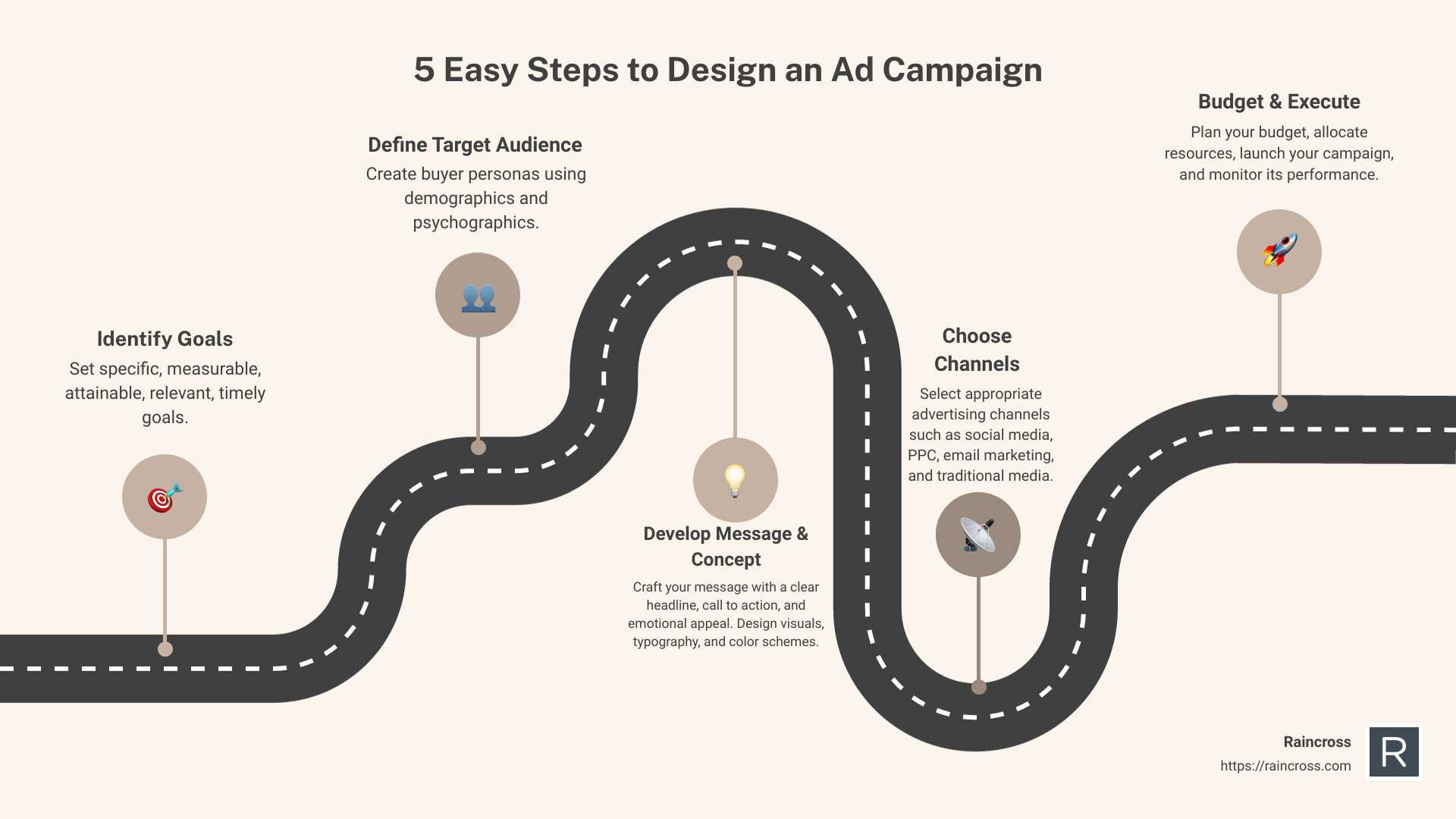
Here’s a quick recap:
- Research and identify your goals.
- Develop your message and creative concept.
- Choose your advertising channels.
- Plan your budget and allocate resources.
- Execute and monitor your campaign.
Creating an effective ad campaign is crucial for reaching your business goals. Whether you’re aiming to boost sales, create brand awareness, or promote a new product, a well-planned campaign can make all the difference.
Having a clear focus and understanding of your objectives helps ensure your message reaches the right audience at the right time. Plus, it aids in measuring success and making necessary adjustments for future campaigns.
By following these steps, you’ll gain the confidence and clarity needed to create impactful ad campaigns that align with your brand and drive results.
Step 1: Research and Goal Identification
The first step in designing an ad campaign is research and goal identification. This phase sets the foundation for your entire campaign, ensuring that your efforts are targeted and effective. Let’s break down the key components:
Identify Your Goals
Your campaign goals should be specific, measurable, attainable, relevant, and timely (SMART). Here’s how to set them:
- Specific: Clearly define what you want to achieve. For example, instead of saying “increase sales,” specify “increase sales of Product X by 20%.”
- Measurable: Use metrics to track progress. This could be sales numbers, website traffic, or social media engagement.
- Attainable: Set realistic goals. Consider your resources and market conditions.
- Relevant: Ensure your goals align with your broader business objectives.
- Timely: Set a deadline. For instance, “achieve a 20% increase in sales within three months.”
An example of a SMART goal could be: “Achieve 50 new product sales through paid social and display advertising for existing and new customers by the end of this quarter.”
Define Your Target Audience
Understanding your target audience is crucial. This involves creating buyer personas and analyzing demographics and psychographics.
- Buyer Personas: These are detailed profiles of your ideal customers. Include information like age, gender, occupation, and purchasing behavior.
- Demographics: Basic statistical data about your audience. This includes age, gender, income level, and education.
- Psychographics: This delves deeper into your audience’s interests, values, and lifestyle. Ask questions like:
- What are their hobbies?
- What problems do they face that your product can solve?
- What type of content do they engage with?
Knowing your audience helps tailor your message and choose the right channels for your campaign.
Analyze Competitors and Trends
Competitor analysis and market trends provide valuable insights. Here’s how to approach it:
- Competitor Strategies: Study your competitors’ campaigns. What are they doing well? Where are they falling short? Tools like SEMrush can help analyze competitor keywords and ad strategies.
- Market Trends: Stay updated on industry trends. Resources like HubSpot offer reports and insights into current marketing trends. Understanding these can help you stay ahead of the curve.
- Industry Reports: Refer to industry-specific reports for data and forecasts. This information can guide your strategy and help identify opportunities.
By thoroughly researching and setting clear goals, you lay a solid foundation for your ad campaign. Next, we’ll delve into developing your message and creative concept.
Step 2: Develop Your Message and Creative Concept
Crafting the Message
Designing ad campaigns starts with a clear and compelling message. Your message should resonate with your target audience and align with your brand’s values and goals.
1. Messaging, Tone, and Style
First, decide on the tone and style of your campaign. If your brand is usually playful and fun, keep that tone unless your campaign calls for a more serious approach. For example, Maltesers usually uses a playful style, but they took a different approach for International Women’s Day, pushing for gender equality.
2. Unique Selling Proposition (USP)
Your USP is what sets you apart from competitors. Make it clear why your product or service is unique. For instance, Dove’s “Real Beauty” campaign stood out by promoting natural beauty standards, which was different from other beauty brands.
3. Headline
Your headline is crucial. It should grab attention and make people want to learn more. Use numbers, make a promise, or evoke curiosity. For example, “Lose 10 Pounds in 10 Days!” is both specific and attention-grabbing.
4. Call to Action (CTA)
A strong CTA tells your audience what you want them to do next. Whether it’s “Buy Now,” “Learn More,” or “Sign Up,” make it clear and compelling.
5. Emotional Appeal
Emotions drive actions. Ads that evoke strong emotions like happiness, fear, or pride can be very effective. For example, an ad showing a happy family using your product can create an emotional connection with your audience.
Designing the Creative Concept
Once you have your message, it’s time to bring it to life with visuals and design elements.
1. Visuals
Visuals are a powerful way to communicate your message. Use images and videos that align with your brand and appeal to your audience. For instance, if you’re targeting young, active individuals, use vibrant and energetic visuals.
2. Typography
Choose fonts that match your brand’s tone. For a modern, sleek look, you might choose a sans-serif font. For a more traditional feel, a serif font could be better. Consistency is key.
3. Color Scheme
Colors evoke emotions and can influence how your message is received. Blue often represents trust and professionalism, while red can evoke excitement and urgency. Choose a color scheme that aligns with your message and brand.
4. Mood Board
A mood board is a visual tool that helps you define the style and feel of your campaign. Include images, colors, fonts, and other design elements that inspire you. This will serve as a reference throughout the design process.

5. Brand Alignment
Ensure that all elements of your campaign align with your brand. Consistency in messaging, tone, and visuals helps build brand recognition and trust.
By focusing on these elements, you can create a compelling and cohesive ad campaign that resonates with your audience and achieves your goals.
Next, we’ll explore how to choose the right advertising channels for your campaign.
Step 3: Choose Your Advertising Channels
Choosing the right advertising channels is crucial for the success of your campaign. The channels you select will determine how well you reach your target audience and meet your goals. Let’s break it down into digital and traditional channels.
Digital Channels
Social Media
Social media platforms like Facebook, Instagram, Twitter, and TikTok are powerful tools for reaching a broad audience. Each platform has its own unique features and user base. For example, Instagram is great for visual content, while Twitter is ideal for quick updates and engagement. Use insights from your market research to choose the platforms where your audience is most active.
PPC (Pay-Per-Click) Ads
PPC ads, such as those on Google Ads, allow you to target specific keywords and demographics. You only pay when someone clicks on your ad, making it a cost-effective way to drive traffic to your website. Google Ads is particularly effective for capturing intent-driven searches, meaning people who are actively looking for what you offer.
Display Ads
Display ads appear on websites within the Google Display Network or other ad networks. These can be banner ads, video ads, or rich media. They are great for brand awareness and retargeting users who have previously visited your site. According to Raincross, display ads can help reach a wider audience at a lower cost compared to other forms of digital advertising.
Email Marketing
Email marketing is a direct way to reach your audience. It’s perfect for nurturing leads, promoting new products, and keeping your brand top-of-mind. Segment your email list to send personalized messages that resonate with different audience segments. For example, Raincross suggests using email to nurture existing leads and advertise new promotions.
Traditional Channels
Print Ads
Print ads in newspapers and magazines can still be effective, especially for reaching older demographics or niche markets. Target publications that your audience reads to maximize your reach.
Radio
Radio ads are excellent for reaching local audiences. They can be particularly effective for promoting time-sensitive offers or local events. Choose stations that align with your audience’s interests and listening habits.
Television
Television ads offer broad reach and are ideal for creating a strong visual and emotional impact. They can be expensive, but they are effective for brand building and reaching a large, diverse audience. Timing your ads during peak viewing hours can increase their effectiveness.
By carefully selecting your advertising channels, you can ensure your campaign reaches the right audience in the most effective way. Next, we’ll look at budgeting and resource allocation to make the most of your chosen channels.
Step 4: Budgeting and Resource Allocation
Setting a Budget
Before diving into your ad campaign, you need a clear budget. Budget planning is crucial to ensure you don’t overspend while reaching your goals.
- Cost Estimation: Start by estimating costs for each advertising channel. For example, social media ads might be cheaper than TV ads, but they might also reach different audiences.
- Channel Prioritization: Focus your budget on the channels most likely to give you a high return on investment (ROI). If your audience is mainly on Instagram, prioritize spending there.
- ROI Analysis: Always factor in potential ROI. For instance, spending $500 on a well-targeted Facebook ad might yield better results than $5,000 on a broad TV ad.
- Pro Tip: Use tools like Google Ads’ Keyword Planner to get cost estimates and forecast potential returns.
Allocating Resources
Once your budget is set, allocate your resources effectively. This includes both human resources and technology.
- Staff Skills: Evaluate your team’s skills. Do you have in-house experts for every task, or will you need external help? For example, if you lack a graphic designer, you might need to hire one.
- Technology: Ensure you have the right technology. Tools like HubSpot for marketing automation or Google Analytics for tracking can be game-changers.
- Outsourcing vs. In-House: Decide if tasks should be done in-house or outsourced. In-house might save money but could take more time if your team lacks expertise. Outsourcing to freelancers or agencies can be faster but more costly.
- In-House: Best for tasks like social media management if you have a dedicated team.
- Freelance: Ideal for specialized tasks like copywriting or video production.
- Agencies: Great for comprehensive services, from strategy to execution, but usually more expensive.
- External Consultants: Sometimes, hiring a consultant for a short period can provide the expertise you need without a long-term commitment. This can be especially useful for strategy planning or complex tasks like SEO.
By carefully setting your budget and allocating resources, you’ll be well-prepared to execute your campaign effectively. Up next, we’ll explore how to launch and monitor your campaign for the best results.
Step 5: Execution and Monitoring
Launching the Campaign
Launching your campaign is an exciting moment, but it requires careful planning. Timing is crucial. For example, if you’re marketing toys, launching your campaign during the holiday season can maximize impact. On the other hand, a campaign for tanning solutions might be more effective during late winter to early spring.
Test Runs and Focus Groups: Before a full-scale launch, conduct test runs or use focus groups from your target market. This helps you gather feedback and make necessary adjustments. For instance, a focus group might reveal that your ad’s message isn’t clear, allowing you to tweak it before the big launch.
A/B Testing: This is a powerful method to optimize your campaign. Create two versions of your ad (A and B) and see which one performs better. This could be different headlines, images, or calls-to-action. The insights you gain will help you refine your campaign for better results.
Pro Tip: Use HubSpot for A/B testing. It offers tools to easily set up and monitor your tests.
Monitoring and Analyzing Results
Once your campaign is live, monitoring its performance is essential. This helps you understand what’s working and what’s not, allowing for timely adjustments.
Performance Tracking: Use tools like Google Analytics, Facebook Ads Manager, and HubSpot to track key metrics. These tools provide insights into click-through rates, conversions, and user engagement.
Analytics Tools: Here’s a quick overview of essential tools:
- Google Analytics: Tracks website traffic, user behavior, and conversion rates.
- Facebook Ads Manager: Monitors ad performance on Facebook, including engagement and conversion metrics.
- HubSpot: Offers comprehensive analytics for email campaigns, social media, and landing pages.
Pro Tip: Bookmark this link for a list of marketing metrics to watch, organized by channel. This helps you quickly scan for new metrics to track.
Retrospective Meetings: After your campaign, hold a retrospective meeting with your team. Discuss what went well and what could be improved. Ask questions like:
- What could’ve been done differently?
- How could we have saved money?
- What did we learn about our audience or marketing channels?
By launching your campaign with precision and continuously monitoring its performance, you can ensure its success and gather valuable insights for future campaigns.
Next, we’ll dive into frequently asked questions about designing ad campaigns.
Frequently Asked Questions about Designing Ad Campaigns
What are the key steps in creating an advertising campaign?
Creating an advertising campaign can seem daunting, but breaking it down into simple steps can help. Here are the key steps:
- Research and Goal Identification: Start by understanding your market and setting SMART goals (Specific, Measurable, Attainable, Relevant, Timely). Research your target audience and analyze your competitors and market trends.
- Develop Your Message and Creative Concept: Craft a compelling message with a strong call to action. Design visual elements that align with your brand.
- Choose Your Advertising Channels: Decide where to place your ads. This could be digital channels like social media and Google Ads, or traditional media like print and TV.
- Budgeting and Resource Allocation: Plan your budget and allocate resources. Decide whether to handle tasks in-house or outsource them.
- Execution and Monitoring: Launch your campaign, conduct A/B testing, and track performance using analytics tools.
These steps ensure a structured approach to designing ad campaigns. Source
How do you define your target audience?
Defining your target audience is crucial for a successful campaign. Here’s how to do it:
- Create Buyer Personas: Develop detailed profiles of your ideal customers. Include demographics like age, gender, income level, and marital status.
- Understand Psychographics: Look at values, interests, and lifestyle. Know what magazines they read, TV shows they watch, and their hobbies.
- Identify Pain Points: Understand the problems your audience faces that your product or service can solve.
- Research Behavior: Determine how your audience interacts online. Do they engage on Instagram or just browse on Facebook?
By getting to know your audience, you can tailor your message to resonate with them. Source
What tools can help in monitoring campaign performance?
Monitoring your campaign’s performance is essential to understand its effectiveness. Here are some tools that can help:
- Google Analytics: Track website traffic, user behavior, and conversion rates. This tool helps you understand how users interact with your site after seeing your ads.
- Facebook Ads Manager: Provides detailed insights into your Facebook ad campaigns. You can track metrics like impressions, clicks, and conversions.
- HubSpot: Offers comprehensive analytics for various marketing channels. You can measure email campaigns, social media, and website performance.
- A/B Testing Tools: Use tools like Optimizely or Google Optimize to run A/B tests on your ads. This helps you determine which versions perform better.
These tools provide valuable data to help you refine your ad campaigns and improve ROI. Source
Next, we’ll wrap up with a summary and look at future trends in advertising.
Conclusion
Summary
Designing ad campaigns can seem overwhelming, but breaking it down into manageable steps makes it simpler. We’ve covered everything from research and goal identification to execution and monitoring. Each step is crucial for creating an effective campaign that resonates with your target audience and achieves your business goals.
Raincross
At Raincross, we specialize in creating innovative and effective digital marketing strategies. Our programmatic ad buying services ensure precise targeting and optimization, enhancing the effectiveness of your campaigns. By combining creative expertise with powerful analytics, we help you reach a larger yet more targeted audience.
Future Trends
The future of advertising is exciting, with emerging technologies like AI and machine learning paving the way for more personalized and effective campaigns. These advancements will allow for even more precise targeting and optimization, ensuring higher returns on investment.
Continuous Improvement
Advertising is not a one-time activity but a continuous process. Regularly monitor your campaigns, analyze the results, and make necessary adjustments. Tools like Google Analytics, Facebook Ads Manager, and HubSpot can provide valuable insights to help you refine your strategies.
By staying updated with the latest trends and continuously improving your campaigns, you can ensure long-term success in the ever-changing digital landscape.
For more information on how Raincross can help you design effective ad campaigns, visit our services page. Let’s shape the future of digital marketing together!