article
Apple Maps Ads Are Now Live
Apple Maps Ads are now live in the United States and Canada. Learn where the ads appear, how they are matched to customers, what businesses are eligible and what steps to take next.

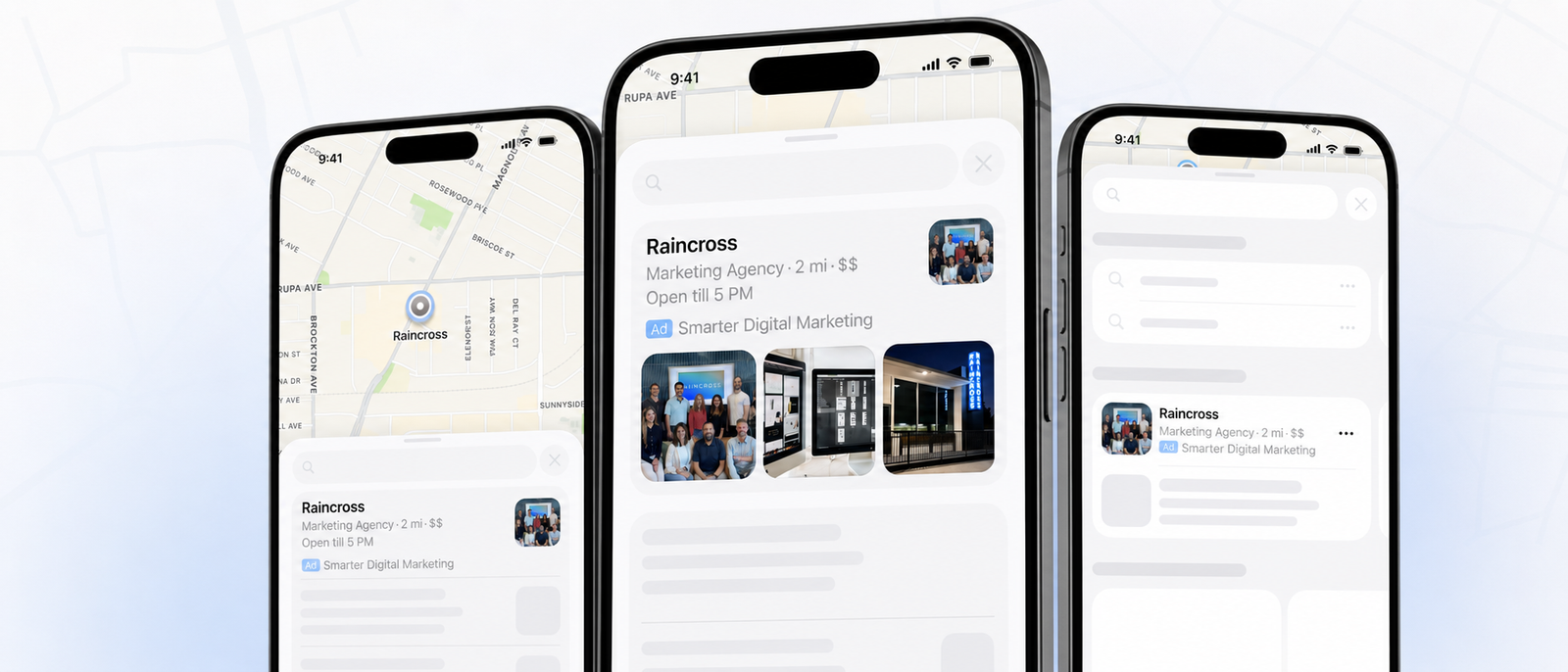
Apple Maps advertising is officially live.
Ads began appearing for users in the United States and Canada in late August 2026, with Apple expected to expand availability to more users over the coming weeks. The rollout gives local businesses a new way to reach customers while they are actively deciding where to go, shop, eat or request a service.
The opportunity is significant. Apple reports that more than one billion relevant searches for businesses take place in Maps every month. According to Apple, approximately one in two business searches results in the user taking an action.
For eligible businesses that depend on calls, directions, website visits and in-person traffic, Apple Maps Ads could become an important addition to their local-search strategy.
Apple Maps Ads Are Already Appearing on iPhones
Apple first announced its plans for Maps advertising in March 2026. The company officially began rolling out the ads in August, and users are now seeing them within the Apple Maps app.
According to The Verge's hands-on coverage, ads have started appearing as the first listing within the Suggested Places section. Apple says they will also appear at the top of relevant search results.
The ads are identified with a blue "Ad" label, similar to the sponsored listings that have appeared in Google Maps for years.
Some users are also receiving an in-app notice explaining that Maps may show local ads based on their approximate location, current search terms or the area of the map they are viewing. Apple emphasizes that advertising information is not connected to the user's Apple Account.
The rollout is being phased in, so not every Apple Maps user will see ads immediately.
Where Apple Maps Ads Appear
Apple has introduced two primary placements within Maps.
Suggested Places
Ads can appear before a customer conducts a specific search, typically as the first listing within Suggested Places.
This placement gives businesses an opportunity to influence customers who are exploring nearby options but have not yet decided exactly what they want or where they intend to go.
Search Results
Ads can also appear at the top of relevant results after a user searches for a business category, product or service.
For example, someone searching Apple Maps for "sporting goods," "restaurants near me" or "hotels" may see a sponsored local business above the organic listings.
This is an especially valuable moment because the customer is demonstrating both intent and proximity. The user is often not simply researching a topic. They are deciding where to go or which business to contact.
What Apple Maps Ads Look Like
Apple designed the ads to resemble a natural extension of the existing Maps experience rather than traditional banner advertisements.
Depending on the placement and available creative assets, an ad may include:
- The business name and category
- Distance from the user
- Business hours
- A promotional message
- A logo or business photos
- A link to the business's place card
- Options to call, visit the website or get directions
Businesses can upload as many as three photos or use one business logo. Advertisers cannot use photos and a logo in the same ad creative.
Choosing three photos makes the ad eligible for all available search-result formats, including three-image, one-image and text-only variations. Apple automatically determines which format to display based on the placement, business category and customer's search.
Advertisers can also add a short promotional message. During Raincross's initial account setup, Apple limited this text to 25 characters. That means businesses must communicate their value proposition very concisely.
For our initial Raincross test, we selected:
- Smarter Digital Marketing
How Businesses Can Create Apple Maps Ads
Before a business can advertise, it must claim and verify its location through Apple Business.
Apple Business now incorporates the brand and location-management features previously offered through Apple Business Connect. Through this platform, businesses can manage information that appears across Apple Maps and other Apple services, including:
- Business name and category
- Address and contact information
- Hours of operation
- Logos and photos
- Place cards
- Special offers
- Custom actions
- Website and reservation links
Once the location is claimed, smaller businesses can use Apple's automated campaign setup to select their locations, upload creative assets, establish a monthly budget and begin advertising.
Businesses can start or pause campaigns at any time.
Agencies, larger businesses and existing Apple Ads advertisers can access more advanced campaign-management options through the Apple Ads platform. These controls can include keyword phrases, categories, Search Match, bidding strategies and more detailed reporting.
How Apple Matches Ads With Customers
Apple Maps advertising is primarily based on contextual intent rather than detailed individual profiles.
Ads may be selected using signals such as:
- The user's current search
- The user's approximate location
- The portion of the map being viewed
- The relevance of the business category
- Nearby trends and Suggested Places
- The advertiser's selected keywords or categories
Apple's Search Match feature can automatically match an eligible business with people searching for what that business offers. More advanced advertisers can also select keyword phrases and business categories directly.
Unlike audience targeting on many social media platforms, the primary opportunity is not to target someone based on a detailed history of interests and behaviors. It is to reach that person at a relevant moment, in a relevant place, while they are looking for somewhere to go.
Bidding and Budget Options
Apple provides both automated and manual bidding options, depending on the campaign setup.
Maximize Engagements
Maximize Engagements is an automated strategy designed to generate as many ad taps as possible within the available budget.
Apple's system automatically adjusts bids based on the search and available advertising opportunities. This strategy uses a cost-per-tap pricing model.
Manage Bids
Manage Bids provides advertisers with more direct control.
Advertisers can choose a cost-per-tap model and establish the maximum amount they are willing to pay for an ad interaction. Apple also offers cost-per-thousand-impressions bidding for certain advanced campaign configurations.
Apple recommends allowing a campaign to run for at least two weeks before making significant changes. This gives the system time to learn from user behavior and available search activity.
Measuring Apple Maps Ad Performance
Apple Maps campaign reporting goes beyond impressions and taps.
Advertisers can measure actions users take after engaging with an ad, including:
- Directions
- Calls
- Website visits
- Photo views
- Shares
- App downloads
Available reporting metrics include:
- Impressions
- Taps
- Tap-through rate
- Spend
- Average cost per tap
- Average CPM
- Actions
- Action rate
- Actions per impression
- First actions
- Average cost per first action
These measurements allow businesses to evaluate whether their advertising is producing meaningful activity rather than traffic alone.
A request for directions, for example, may be a much stronger indication of purchase intent than a general website visit.
Businesses should still use website analytics, call tracking and customer-management systems whenever possible. Apple can measure actions occurring within Maps, while the advertiser's own systems can help determine whether those actions ultimately produce appointments, leads or sales.
Apple's Privacy-First Advertising Approach
Apple is positioning privacy as one of the primary differences between Maps Ads and other digital advertising platforms.
Apple Maps may use the customer's approximate location, current search terms and map view to provide geographically relevant advertising. However, Apple says a user's location and interactions with Maps ads are not associated with that person's Apple Account.
Apple also states that personal information stays on the user's device and is not collected, stored or shared with third parties for Maps advertising.
According to Apple, its advertising platform does not use or store a customer's precise location for advertising or build advertising profiles based on a person's location history.
This privacy-first structure may limit some of the advanced audience targeting and attribution advertisers use on other platforms. At the same time, it gives businesses access to a strong contextual signal: what someone is searching for and where they are searching for it.
Not Every Business Can Advertise
An active Apple Maps listing does not automatically make a business eligible to run ads.
Apple currently prohibits Maps advertising for several categories, including:
- Plumbing
- Electrical services
- Locksmiths
- HVAC services
- Pest control
- Roofing
- General contracting
- Bail bond services
- Cryptocurrency ATMs
- Political candidates, parties and issues
Additional restrictions apply to alcohol, gambling, medical services, religious advertising and other regulated categories. Some advertisements may be evaluated individually based on their content, location and applicable laws.
These restrictions are especially important for agencies and businesses accustomed to advertising home services through Google Search, Google Maps or Local Services Ads.
Apple's policies may evolve as the platform matures, but businesses should verify eligibility before allocating a budget or developing campaign creative.
Apple Maps Ads Versus Google Maps Ads
Google remains the dominant local-search advertising platform, and Apple Maps Ads should not immediately be viewed as a replacement for Google Ads.
Instead, Apple Maps creates an additional local-discovery channel.
Many consumers use Apple Maps because it is already integrated into the iPhone and connects with Siri, Safari, Spotlight, CarPlay and other Apple experiences. Those users may never perform the same search through Google Maps.
Apple Maps Ads therefore provide access to a distinct segment of customers at the exact moment they are deciding which business to visit or contact.
An effective local-search strategy may now include:
- Apple Maps optimization
- Google Business Profile optimization
- Local SEO
- Apple Maps advertising
- Google Search and Maps advertising
- Consistent business information
- Customer reviews
- High-quality location photography
- Call and website conversion tracking
Advertising can increase visibility, but it cannot compensate for inaccurate hours, weak photos, incorrect categories or an incomplete business listing.
Why Raincross Is Testing Apple Maps Ads
Raincross is establishing an Apple Maps Ads test account to evaluate the platform firsthand.
The setup has already given our team an opportunity to review the available ad formats, creative requirements, promotional-text limits, business verification process and campaign controls.
Our test will focus on several key questions:
- How accurately does Apple match ads with relevant local searches?
- Which placements generate the strongest engagement?
- How do costs compare with Google's local-search inventory?
- Which business categories receive sufficient search volume?
- Do ad taps result in calls, directions and website visits?
- Can Apple Maps produce measurable incremental business?
As with any newly launched advertising platform, early performance should be evaluated carefully. Lower competition could create attractive costs for early advertisers, but a new platform also comes with fewer benchmarks and less historical optimization data.
Our objective is not simply to generate inexpensive taps. We want to determine whether Apple Maps advertising can consistently produce meaningful business actions and identify which clients are best positioned to benefit.
What Businesses Should Do Now
Even if a business is not ready to advertise, Apple's launch reinforces the importance of maintaining an accurate presence within Apple Maps.
Businesses should take the following steps:
- Claim and verify every location through Apple Business.
- Confirm the business name, address, phone number, categories and operating hours.
- Upload current, professional photos representing the location and its offerings.
- Review website, reservation, ordering and other action links.
- Confirm that the business category is eligible for Apple Maps advertising.
- Decide which customer actions will define campaign success.
- Establish a controlled test budget.
- Compare Apple Maps performance against existing local-search channels.
A New Local-Search Opportunity
Apple Maps Ads give businesses another way to reach customers during one of the most valuable moments in the buying journey: when digital discovery is about to become a call, website visit or physical trip.
The platform is new, its advertising competition is still developing and its performance will vary by category and location. But for eligible businesses with strong listings and a clear measurement strategy, Apple Maps Ads are worth testing.
Raincross is actively evaluating the platform and helping businesses determine how Apple Maps advertising fits within a broader paid search and local visibility strategy.
Contact Raincross to discuss whether Apple Maps Ads make sense for your business.
Let's talk about what this means for your business
Tell us where you are and what you are trying to move. We will tell you what we would do first.