article
What Is a DSP in Programmatic Advertising?
A demand-side platform lets advertisers buy ad placements across many websites, apps and streaming services from one interface. Here is how it works and what to watch.

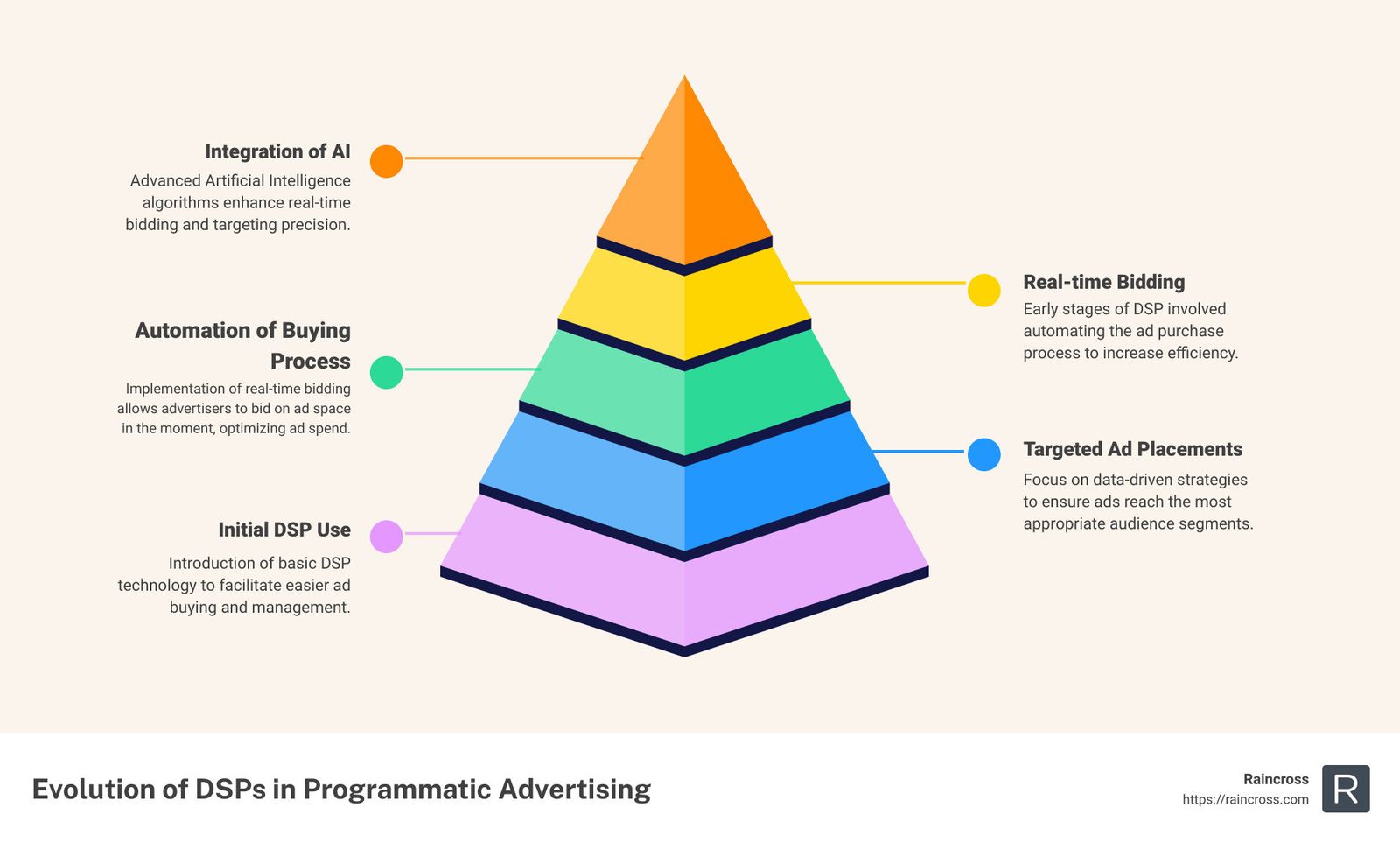
A demand-side platform (DSP) is software advertisers and agencies use to buy digital ad placements across many publishers from one interface. Instead of negotiating with each website, app or streaming service separately, the buyer sets the audience, budget, bid and creative in the DSP, and the platform buys matching impressions automatically. Common examples include Google Display & Video 360, The Trade Desk, Amazon DSP and Yahoo DSP.
DSPs are mostly used by agencies, in-house media teams and larger advertisers that want reach beyond a single platform, such as display, online video, connected TV, streaming audio and digital out-of-home, all managed and measured together.
How does a DSP work?
When a person loads a page or app that sells ad space, the publisher's side of the system makes that impression available. The DSP evaluates it against each campaign's rules, including audience, location, device, content and price, then decides whether to bid and how much. If the bid wins, the ad is served. This happens in a fraction of a second.
Around that core decision, a DSP handles the work that used to be manual:
- Targeting: audiences built from first-party lists, contextual signals, location and licensed data segments.
- Pacing: spreading budget across the flight so it is not spent in the first few days.
- Frequency control: limiting how often the same person sees an ad.
- Optimization: shifting spend toward placements and audiences that perform against the campaign goal.
- Reporting: impressions, reach, cost, clicks, video completions and conversions in one place.
Is programmatic the same as real-time bidding?
No. Real-time bidding (RTB) is one way to buy programmatically, through an open auction for each impression. Programmatic buying is broader. It also includes private marketplaces, where a publisher invites selected buyers to an auction; preferred deals, where a buyer gets first look at inventory at a fixed price; and programmatic guaranteed, where volume and price are agreed in advance and delivered through the DSP. Many quality-focused campaigns lean on these deal types rather than the open auction alone.
DSP vs. SSP vs. ad exchange vs. ad network
| Tool | Who uses it | What it does |
|---|---|---|
| DSP (demand-side platform) | Advertisers and agencies | Buys impressions across many sources based on audience, price and campaign rules. |
| SSP (supply-side platform) | Publishers | Packages and sells a publisher's ad space to many buyers, aiming for the best price. |
| Ad exchange | Both sides, through DSPs and SSPs | The marketplace where impressions are auctioned between buyers and sellers. |
| Ad network | Advertisers and smaller publishers | Aggregates inventory from many sites and resells it, usually as packaged placements with less transparency into exactly where ads run. |
Is Meta Ads Manager a DSP?
Not in the usual sense. Meta Ads Manager buys ads on Meta's own properties, such as Facebook, Instagram and Messenger, plus Meta's Audience Network. It is a closed platform: the inventory, data and measurement all belong to one company. Google Ads works similarly for Search and YouTube. A DSP buys across many independent publishers and exchanges. Most media plans use both, with closed platforms for their specific audiences and a DSP for reach across the open web and streaming TV. Our Paid Social and Programmatic Media Buying teams plan them together for that reason.
A hypothetical example
This is an illustration, not a client result. A regional home services company wants homeowners within 25 miles to remember its name before they need a repair. Through a DSP, it might:
- Upload its customer list to exclude existing customers and build a similar-audience segment.
- Run connected TV spots in its service area to build awareness.
- Follow with display ads on local news and home improvement sites through a private marketplace.
- Cap frequency at a few exposures per person per week.
- Measure website visits, calls and form fills from people who were exposed, compared against a holdout group that was not.
The point of the example is the structure: one plan, several formats, shared frequency control and one measurement view.
What should you watch when buying through a DSP?
- Inventory quality: use allow lists, curated deals and supply path controls so budget goes to real sites and apps people actually use.
- Brand suitability: decide which content categories you will and will not appear next to, and apply verification tools to enforce it.
- Frequency: without caps, a small audience can see the same ad far too often.
- Fees: DSP platform fees, data costs, verification costs and agency management fees all sit between your budget and the media. Ask for them to be itemized.
- Measurement limits: cookie restrictions, privacy rules and view-through attribution make some reported conversions uncertain. Incrementality tests and holdout groups give a more honest read.
When is an agency useful?
Most DSPs have minimum spend requirements and a learning curve. An agency makes sense when you want access to several formats without managing seats and contracts yourself, need help setting up deals and brand safety controls, or want reporting that connects programmatic spend to the rest of your media. If your budget is small and your audience lives on one platform, a closed platform may be the simpler starting point. Our guide to what a media buyer does covers how to evaluate that support.
Frequently asked questions
Who uses a DSP?
Agencies, in-house media teams and advertisers with enough budget to buy across many publishers. Smaller advertisers usually reach DSP inventory through an agency rather than holding their own seat.
What is the difference between a DSP and an SSP?
A DSP works for the buyer and tries to win the right impressions at the right price. An SSP works for the publisher and tries to sell each impression for the best price. They meet through ad exchanges and direct deals.
Can I target by location with a DSP?
Yes. Most DSPs support targeting by country, region, ZIP code, radius around an address and, for some formats, more precise location signals, subject to privacy rules and data availability.
Does a DSP guarantee better results than social or search ads?
No. A DSP gives access and control across more inventory. Whether it outperforms other channels depends on the audience, creative, budget and how results are measured.
How do I know where my ads ran?
Ask for placement or domain-level reporting and use third-party verification. If a partner cannot show where ads appeared, treat that as a warning sign.
Let's talk about what this means for your business
Tell us where you are and what you are trying to move. We will tell you what we would do first.