guide
The Guide to Effective Footfall Measurement
Footfall measurement connects advertising exposure to physical location visits. Learn how visit attribution works, which metrics matter, and how to build a credible measurement strategy.

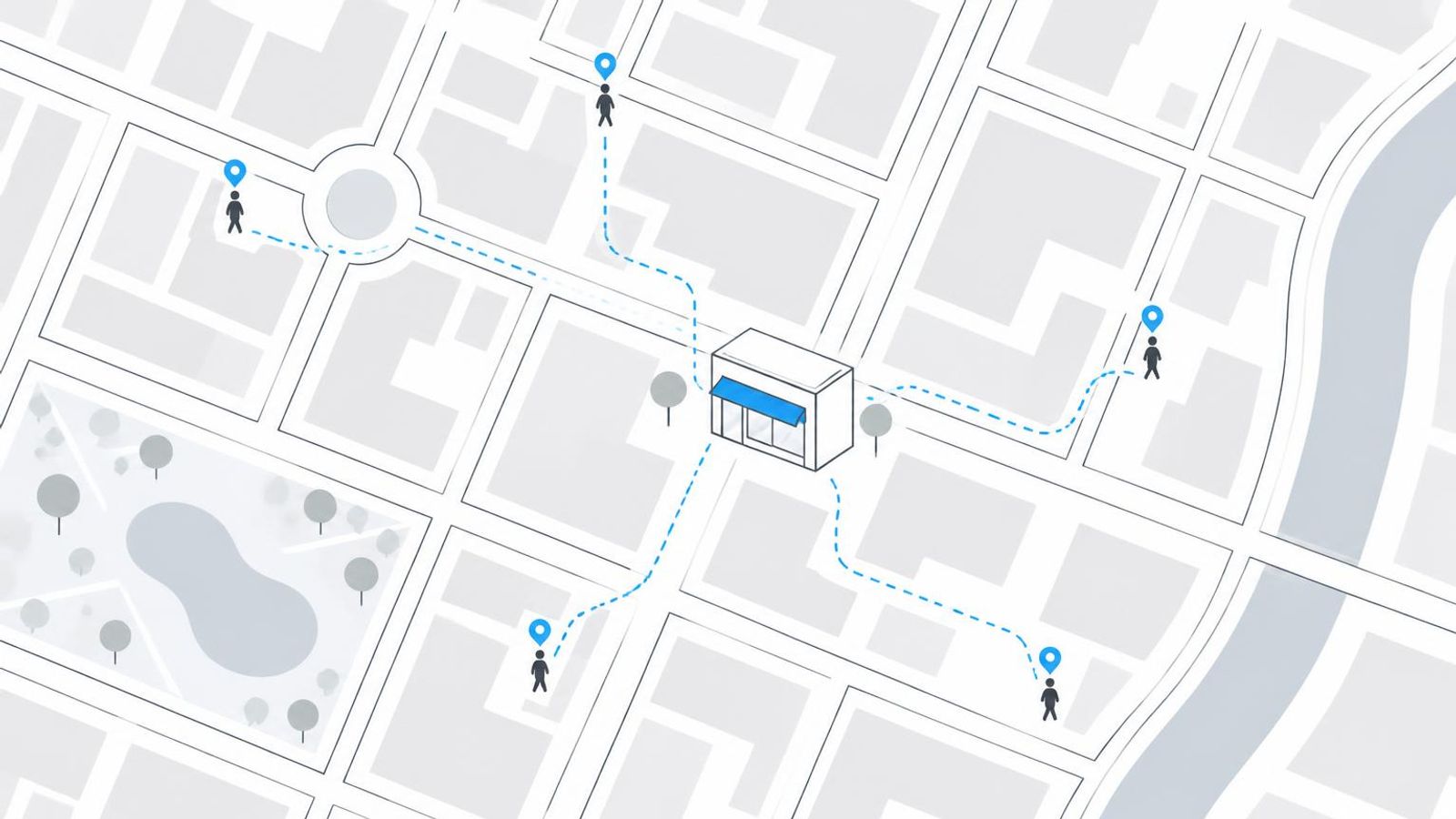
Digital advertising produces an enormous amount of data. Marketers can measure impressions, clicks, website visits, form submissions, phone calls, and online purchases with remarkable precision.
But what happens when the desired action takes place offline?
For retailers, restaurants, entertainment venues, tourism destinations, universities, healthcare providers, and other location-based organizations, a website conversion may tell only part of the story. The real objective is often getting someone to visit a physical location.
Footfall measurement helps connect advertising exposure to real-world visits, giving marketers a clearer understanding of how their campaigns influence offline behavior.
What Is Footfall Measurement?
Footfall measurement, also called foot-traffic attribution or visit attribution, is the process of estimating how many people visited a physical location after being exposed to an advertising campaign.
A measurement provider begins by defining the geographic boundaries of each location. These boundaries, sometimes called polygons, should closely match the physical area customers can access. This is the same discipline that underpins geofencing campaigns.
The provider then analyzes permission-based location signals from mobile devices to determine whether someone exposed to an advertisement later entered the defined location and met the requirements for a qualifying visit.
This allows marketers to evaluate campaigns based on physical outcomes instead of relying exclusively on digital interactions.
Footfall measurement can help answer questions such as:
- Did the campaign contribute to more store visits?
- Which markets or locations generated the strongest response?
- Which audiences were most likely to visit?
- How long did it take someone to visit after seeing an advertisement?
- Which messages, channels, or creative variations performed best?
- Did the campaign create incremental visits beyond normal customer traffic?
These insights help connect digital media with the activity taking place inside physical locations.
A Visit Is Not Automatically a Sale
Footfall measurement provides an important signal, but it must be interpreted correctly.
A location signal may indicate that a device entered a defined area. It does not necessarily confirm that the person made a purchase, scheduled an appointment, attended an event, or completed another business transaction.
It also does not explain every reason someone visited the location.
This is why footfall data is most valuable when evaluated alongside other business information, including:
- Point-of-sale revenue
- Transactions
- Reservations
- Lead volume
- Phone calls
- Website engagement
- Promotional redemptions
- Store-level performance
- Event attendance
Combining multiple sources creates a more complete picture of campaign performance.
How Footfall Measurement Works
Although methodologies vary by platform and measurement provider, most footfall studies involve four primary components.
1. Define the Locations
The first step is determining exactly what should count as a visit.
Each store, restaurant, office, venue, or destination must be mapped accurately. Broad or inaccurate boundaries can include neighboring businesses, parking areas, roads, employees, or people simply passing through the area.
The quality of the location data directly affects the quality of the measurement.
2. Record Advertising Exposure
The advertising platform records qualifying campaign exposures. Depending on the campaign, these exposures may come from programmatic media buying, online video, connected television, digital audio, mobile advertising, digital out-of-home, or other measurable channels.
This creates an exposed audience that can be evaluated for subsequent location visits.
3. Identify Qualifying Visits
The measurement provider analyzes consented location signals to determine whether an exposed device entered a defined location.
Additional requirements may be used to improve accuracy, including minimum dwell times, attribution windows, signal-quality thresholds, repeat-visit rules, and employee filtering.
4. Compare the Results
Raw visit totals do not necessarily prove that advertising caused additional traffic. Some members of the exposed audience may have visited the location regardless of the campaign.
A stronger analysis compares the exposed audience with a baseline, historical period, modeled expectation, or control group. This helps determine whether the campaign produced an incremental increase in visits.
The Footfall Metrics That Matter
Several measurements can help marketers understand campaign performance.
Attributed Visits
Attributed visits represent the estimated number of qualifying location visits associated with campaign exposure.
This can be a useful directional metric, but it should be reviewed alongside the methodology used to calculate it.
Visit Rate
Visit rate measures the percentage of the measurable exposed audience that later generated a qualifying visit.
It can help compare performance across audiences, markets, creative variations, and campaign periods.
Incremental Lift
Incremental lift estimates how much visitation increased compared with what would likely have occurred without the campaign.
This is often more meaningful than a raw visit count because it attempts to separate normal customer activity from visits influenced by advertising.
Cost per Visit
Cost per visit divides campaign investment by the number of attributed or incremental visits.
Marketers should confirm which type of visit is being used in the calculation. A cost per attributed visit is not the same as a cost per incremental visit.
Time to Visit
This measures the amount of time between advertising exposure and a qualifying location visit.
Understanding this window can help marketers refine campaign timing, promotions, messaging, and remarketing strategies.
Frequency Effect
Frequency analysis examines whether people exposed to an advertisement multiple times were more likely to visit.
This can help identify whether additional impressions are improving performance or simply creating unnecessary repetition.
Why Incrementality Matters
Imagine that 1,000 people who saw an advertisement later visited a store. That number may sound impressive, but it does not tell us how many of those people would have visited anyway.
Incrementality asks a more useful question: did the campaign generate more visits than we would reasonably expect without the advertising?
A credible control group or baseline can help estimate the difference between normal behavior and campaign-influenced behavior.
This distinction is especially important for established brands, seasonal businesses, frequently visited locations, and campaigns targeting existing customers. These organizations may naturally generate substantial traffic even when no advertising is running.
Data Quality Is More Important Than Data Volume
More location signals do not automatically produce more reliable measurement.
Marketers should understand where the information comes from, how it was collected, how locations were defined, and what rules were used to classify visits.
Questions to ask a measurement partner include:
- Was the location information collected with appropriate consumer permission?
- How are location boundaries created and verified?
- What level of signal accuracy is required?
- How is dwell time used to distinguish a visit from someone passing by?
- How are employees and repeat visitors treated?
- How are neighboring businesses or shared buildings handled?
- Is the measured audience large enough to support the conclusions?
- Which parts of the report are observed and which are modeled?
- Can the methodology and assumptions be clearly explained?
If a provider cannot explain how its numbers were produced, marketers should be cautious about using those numbers to make major budget decisions.
AI finds the signals. Human intelligence determines what matters.
Privacy Must Be Built Into the Measurement Strategy
Precise geolocation can reveal sensitive information about a person’s movements and behavior. Privacy should therefore be treated as a fundamental requirement, not an afterthought.
Responsible footfall measurement should prioritize:
- Appropriate consumer consent
- Clear disclosures and consumer controls
- Data minimization
- Limited and documented uses
- Reasonable retention periods
- Vendor accountability
- Secure data handling
- Aggregated reporting
- Restrictions involving sensitive locations
Marketers should work with advertising and measurement partners that can explain how their data is sourced, protected, processed, and reported.
Privacy requirements can vary based on the organization, location, industry, audience, and way the information is used. Businesses should consult their legal and privacy teams when developing programs involving location data.
Build Measurement Into the Campaign From the Beginning
Footfall measurement works best when it is part of the original media planning and buying strategy.
Trying to add attribution after a campaign has already started can result in missing exposure data, incorrect location boundaries, insufficient audience volume, or unclear success criteria.
Before launching, marketers should define:
- The business objective
- Participating locations
- Geographic markets
- Target audiences
- Advertising channels
- Campaign duration
- Attribution window
- Visit requirements
- Baseline or control methodology
- Primary performance indicators
- Optimization thresholds
This creates a shared definition of success before results begin influencing decisions.
Turning Footfall Insights Into Action
Footfall data becomes valuable when it changes what happens next.
Marketers can use the findings to:
- Shift investment toward stronger markets or locations
- Refine geographic targeting
- Adjust audience strategies
- Compare creative messages and offers
- Identify the most productive exposure frequency
- Coordinate campaigns with seasonal demand
- Improve the timing of promotions
- Balance investment across media channels
- Compare campaign activity with store-level business results
However, teams should avoid making major changes based on small samples or short-term fluctuations. Location measurement is most useful when trends are consistent, methodologies are transparent, and findings are supported by other performance indicators. Pairing it with disciplined analytics and reporting keeps the interpretation honest.
The Raincross Approach to Footfall Measurement
At Raincross, we view footfall measurement as one part of a broader performance strategy.
We begin with the business outcome, not the advertising platform. That means understanding which locations matter, what type of visit creates value, which audiences should be reached, and how the results will inform future decisions.
From there, we can incorporate footfall measurement into campaigns involving programmatic display, video, digital audio, connected television, geofencing, paid social, paid search, digital out-of-home, and other relevant media channels.
We evaluate location outcomes alongside campaign delivery, website analytics, search activity, lead generation, and available business data. This helps distinguish a compelling dashboard metric from an insight that can actually improve performance.
Footfall measurement will never explain every customer decision. When designed carefully, however, it can help close the gap between digital advertising and the real-world actions that matter to your organization. Talk with our team about where to start.
Connect Advertising With Real-World Results
If your organization wants to understand whether its advertising is contributing to physical visits, Raincross can help develop a measurement strategy aligned with your locations, media plan, audience, and business objectives.